Gulfwatch Contaminants Monitoring
Gulfwatch Sample Archive Available for Research
Thanks to funding from Fisheries and Oceans Canada’s (DFO) Marine Environmental Quality Program, the Huntsman Marine Science Centre is providing archival support for the Gulf of Maine Council’s collected Gulfwatch mussel samples.
Gulfwatch’s transboundary chemical contaminants monitoring program involved the collection of blue mussels (Mytilus edulis) at rotating sites in all jurisdictions around the Gulf of Maine (i.e., Nova Scotia, New Brunswick, Maine, New Hampshire and Massachusetts). Samples were collected between 1993 through 2012. The existence and preservation of these samples presents an invaluable opportunity to:
- gain a regional perspective on the distribution and concentrations of toxic contaminants,
- establish a baseline reference for future monitoring efforts, and
- improve our understanding of issues that threaten the overall environmental quality of coastal waters within the Gulf of Maine and Bay of Fundy region.
Researchers interested in accessing archived samples must submit a research proposal to the Gulfwatch Archive Steering Committee. Proposal submission guidelines must be followed as outlined within the Gulfwatch Management Plan.
Background
Gulfwatch was a chemical-contaminants monitoring program organized and administered by the Gulf of Maine Council on the Marine Environment. Between 1993 and 2012, Gulfwatch measured contaminants in blue mussels (Mytilus edulis) to assess the types and concentration of contaminants in coastal waters of the Gulf of Maine.
Gulfwatch was coordinated and conducted by scientists and managers from agencies and universities around the Gulf. The program operated under the guidance of the Gulf of Maine Council’s Gulfwatch Contaminants Monitoring Committee and was supported with funding from the Gulf of Maine Council on the Marine Environment and the U.S. Environmental Protection Agency.
Each fall, scientists collected blue mussels, rotating among 38 sites around the Gulf of Maine, and analyzed their whole tissues for a variety of contaminants. Additional sites were sampled in a particular year as part of other projects associated with Gulfwatch. Data indicated where contaminant concentrations may be high and enabled researchers to compare concentrations at different locations. Data also showed changes in concentrations over time.
Dozens of chemicals and metals were monitored
Polycyclic aromatic hydrocarbons (PAHs) come from municipal and industrial effluents, fossil fuel combustion, wastewater from refineries and offshore oil rigs, and petroleum spills. Gulfwatch measured 12 low-molecular-weight PAHs and 12 high-molecular-weight PAHs.
Polychlorinated biphenyls (PCBs) are synthetic chemicals comprised of chlorine atoms arranged on a biphenyl molecule. They are highly persistent in the environment and may be highly toxic. Gulfwatch measured 22 PCBs.
Chlorinated pesticides are synthetic chemicals that have been used as pesticides, such as DDT and dieldrin. Most are highly persistent in the environment. Gulfwatch measured 16 chlorinated pesticides.
Metals occur naturally but human activities may increase their concentration and availability from fertilizers, fossil fuel combustion, metal smelting, industries, and domestic waste. Gulfwatch measured 9 metals.
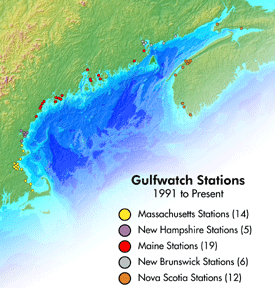
Sites ranged from Massachusetts to Nova Scotia
Gulfwatch samples were collected from more than three dozen sites along the coast of Massachusetts, New Hampshire, Maine, New Brunswick, and Nova Scotia. List of sampling sites, including site names, latitude/longitude, years sampled, and substrate:
List of sampling sites: Excel file (28 KB)
Data
Tables of Gulfwatch data can be viewed online (HTML) or downloaded as tab-delimited text files or Microsoft Excel Version 8.0 for PC spreadsheets. To view or download data, click on a link in the table below. Links in the table indicate data file size. ND indicates No Data.
| PCB data | Pesticide data | |||||
|---|---|---|---|---|---|---|
| View online (HTML) | Text file | Excel 8.0 file (PC) | View online (HTML) | Text file | Excel 8.0 file (PC) | |
| 1991 | ND | ND | ND | ND | ND | ND |
| 1992 | 102K | 11K | 50K | 75K | 8K | 39K |
| 1993 | 126K | 13K | 60K | 97K | 10K | 47K |
| 1994 | 145K | 15K | 68K | 114K | 12K | 52K |
| 1995 | 141K | 12K | 58K | 110K | 10K | 48K |
| 1996 | 16K | 4K | 140K | 12K | 4K | 103K |
| 1997 | 16K | 4K | 140K | 12K | 4K | 103K |
| 1998 | 96K | 12K | 140K | 76K | 12K | 103K |
| 1999 | 96K | 16K | 140K | 64K | 12K | 103K |
| 2000 | 80K | 16K | 140K | 64K | 12K | 103K |
Publications and Reports
- Chamberlain, Sarah. Developing and implementing a research framework to determine the use and influence of a long-term marine environmental monitoring program: A Case Study on Gulfwatch in Nova Scotia
- S. Chamberlain and P.G. Wells. 2014 Gulfwatch Bibliography, October 2014
- M.E. Chase, S.H. Jones, P. Hennigar, J. Sowles, G.C.H. Harding, K. Freeman, P.G. Wells, C. Krahforst, K. Coombs, R. Crawford, J. Pederson and D. Taylor. 2001. Gulfwatch: Monitoring Spatial and Temporal Patterns of Trace Metal and Organic Contaminants in the Gulf of Maine (1991-1997) with the Blue Mussel, Mytilus edulis L
- Fried, S. 1999. Gulfwatch: Putting a little mussel into Gulf of Maine marine monitoring. Fundy Issues #12. Bay of Fundy Ecosystem Partnership.
- Gottholm, B.W., and D.D. Turgeon. 1992. Toxic Contaminants in the Gulf of Maine. NOAA, National Ocean Service, Office of Ocean Resources of Maine. NOAA, National Ocean Service, Office of Ocean Resources of Maine Conservation and Assessment, Rockville, MD.
- Gulfwatch 2010 Data Report (PDF, 1.71 MB)
- Gulfwatch Data Reports (1991-2009: PDF Format)
- Gulfwatch fact sheet: Monitoring contaminants in Gulf of Maine coastal waters
- Jones S.H., M. Chase, J. Sowles, P. Hennigar, N. Landry, P.G. Wells, G.C.H. Harding, C. Krahforst, and G.L. Brun. 2001. Monitoring for toxic contaminants in Mytilus edulis from New Hampshire and the Gulf of Maine. Journal of Shellfish Research 20:1203-1214.
- Jones, Steve, Krahforst, Christian, and Harding, Gareth. Distribution of mercury and trace metals in shellfish and sediments in the Gulf of Maine
- Nine-year review of Gulfwatch in the Gulf of Maine: Trends in tissue contaminant levels in the blue mussel, Mytilus edulis L., 1993—2001
- O’Connor, T.P. 1998. Mussel Watch results from 1986 to 1996. Marine Pollution Bulletin 37:14-19.
- Pesch, G., and Wells, P. Eds. 2004. Tides of Change Across the Gulf: An Environmental Report on the Gulf of Maine and Bay of Fundy
- James D. Ross, L. Danielle Hubbard, Ruth E. Cordes, Bertrum H. MacDonald, and Peter G. Wells. Celebrating 25 Years of Knowledge on the Gulf: A Bibliography of Publications of the Gulf of Maine Council on the Marine Environment
- Swam, Lauren M., Apeti, Dennis A., Rider, Mary M., Jones, Stephen; Reed, Lou Ann. (2023). An Assessment of Legacy Organic Contaminants and Trace Metals in the Gulf of Maine. National Centers for Coastal Ocean Science (U.S.), Consolidated Safety Services, Inc., and University of New Hampshire. NOAA technical memorandum NOS NCCOS: 319. DOI: https://doi.org/10.25923/atf4-1t66.
- Wells, P.G. 2003. Assessing health of the Bay of Fundy: Concepts and Framework. Marine Pollution Bulletin 46: 1059-1077.
- Wells, P.G. 2005. Chapter 17. Assessing marine ecosystem health – concepts and indicators, with reference to the Bay of Fundy and Gulf of Maine, Northwest Atlantic. In Jorgensen, et al. Handbook of Ecological Indicators, Francis and Taylor / CRC Press, Boca Raton, FL., pages 395-430.
Contact Us
For information about Gulfwatch, please contact Peter Wells, Canadian Co-chair of the Gulfwatch Contaminants Monitoring Committee, oceans2@ns.sympatico.ca